Agent Security Stack
The reason for this stack is simple: coding agents are useful, but you cannot let them run loose with live keys, weak dependency provenance, and broad ambient environment access. The security stack is bondage for launch policy, envchain-xtra for secret release, and nono for sandbox enforcement.
Last updated
Architecture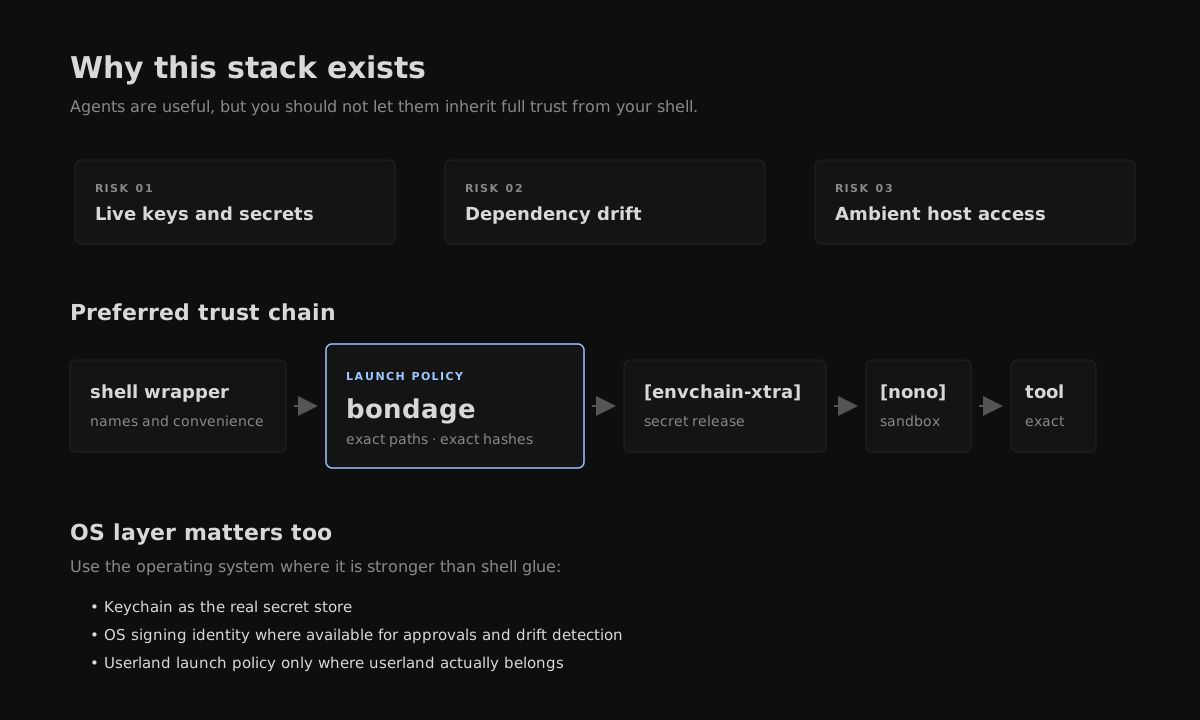
1. Why this stack exists
By default, most agent setups inherit too much trust from the surrounding shell session. That means too many secrets, too much filesystem visibility, and too much confidence in whatever dependency tree happens to answer on PATH.
The actual reasons for hardening this are not abstract:
- you do not want agents running loose with live API keys and other secrets
- you cannot assume the dependency tree behind a familiar command is clean or stable
- you do not want broad ambient access to shell state, config files, and local environment by default
The old pattern for hardening CLI agents was to stuff everything into shell wrappers: secret injection, Touch ID gates, sandbox flags, target resolution, and sometimes even binary verification. That can work, but it makes your shell script the real security boundary.
The cleaner model is to separate the jobs:
That split matters because each layer addresses a different failure mode: bondage decides what exact artifact chain is allowed to launch, envchain-xtra decides when secrets are released, and nono decides what the launched process can actually touch.
It also deliberately leans on the OS where the OS is stronger than userland glue: macOS code-signing identity can be used as part of artifact approval, and Keychain remains the underlying secret store rather than re-implementing secret storage in the launcher.
If you want the implementation detail rather than the overview, start with agentbondage.org, then read the Getting Started and Trust Model docs.
2. Philosophy
This stack is opinionated. The philosophy is not “wrap everything in enough cleverness and call it secure.” It is to reduce ambient trust and make the risky decisions explicit.
- Prefer explicit trust over ambient trust. Exact paths, exact hashes, explicit profiles, explicit secret release.
- Use the OS for what the OS is good at. Keychain for secret storage, signing identity where available, kernel sandboxing for enforcement.
- Keep layers narrow. Launch policy is not secret storage. Secret storage is not sandbox policy. Shell convenience is not a trust boundary.
- Assume upgrades are security events. If a binary or package tree changed, re-approve it deliberately.
- Make escape hatches obvious. If there is a no-sandbox path, it should be explicit and ugly, not a quiet profile drift.
In short: less magic, less ambient authority, more deliberate boundaries.
3. Layer responsibilities
| Layer | What it should do | What it should not do |
|---|---|---|
| Shell wrapper | Short names, prompt shaping, convenience aliases | Decide which binary is trusted or which sandbox policy applies |
bondage |
Verify exact targets, interpreters, package trees, and choose the launch policy | Store secrets or enforce filesystem policy by itself |
envchain-xtra |
Release secrets from Keychain-backed namespaces to one process tree | Own the whole launch-policy story |
nono |
Enforce filesystem, process, and network restrictions | Resolve which launch artifact chain is trusted |
4. Practical patterns
The stack guide should explain the worldview, not carry every operational nuance inline. The sharp edges are better captured as repeatable patterns.
- vendor-independence — keep instructions, plugins, tool access, and security layers portable across clients instead of baking the workflow into one vendor.
- claude-to-codex-plugins — take a Claude-first plugin and make Codex first-class without forking the real workflow, using llm-wiki as the case study.
- visual-inspection — use accessibility trees first, then a narrow localhost screenshot service when pixels actually matter.
- sandbox-profiles — keep normal coding tight, make broader access explicit, and make true bypasses obvious.
These are the decisions that matter more than the exact command syntax: where the trust boundary lives, which capability gets isolated, and what counts as a real escape hatch.
5. Install
Quick bootstrap
If you want a working starter shape instead of hand-copying every profile, use agent-stack-bootstrap. It installs public templates and shell aliases, while keeping real local paths, fingerprints, hostnames, and tokens in private generated or ignored files.
git clone https://github.com/nvk/agent-stack-bootstrap.git
cd agent-stack-bootstrap
./install.sh
echo 'source "$HOME/.config/agent-stack/shell.zsh"' >> ~/.zshrc
The default install includes every optional public profile group. Pick narrower groups when you only need one path:
./install.sh --profiles spark
./install.sh --profiles ds4,pi-ds4
./install.sh --profiles none
The bootstrap stages bondage.conf.template; it does not install a live pinned ~/.config/bondage/bondage.conf. Render and pin that file locally after the target tools are installed.
The bootstrap also installs requirements.env and a version check helper. As of this guide update, the tested public ranges are nono >=0.61.0 <0.62.0, agent-bondage >=0.2.7 <0.3.0, envchain-xtra >=1.3.1 <2.0.0, node >=26.0.0 <27.0.0, codex >=0.136.0 <0.137.0, claude-code >=2.1.112 <2.2.0, and opencode >=1.14.40 <1.16.0.
Manual install
Start with the launcher and the sandbox:
brew tap nvk/tap
brew install nvk/tap/agent-bondage
brew install nono
The current public baseline is agent-bondage 0.2.7, envchain-xtra 1.3.1 when you use Keychain secret release, and nono 0.61.1. If you use registry-managed nono packs for agent profiles, keep the packs pinned too: always-further/codex@0.0.12, always-further/claude@0.0.16, and always-further/opencode@0.0.5.
If a profile needs Keychain-backed secret injection, add:
brew install nvk/tap/envchain-xtrabondage executable.
Useful references:
- Bondage site
- Bondage source
- envchain-xtra source
- Homebrew tap
- agent-stack-bootstrap — public, non-doxing starter templates and installer for the local profile shape used in these guides
6. Recommended layout
Keep the pieces separate:
~/.config/bondage/bondage.conf
~/.bondage/tools/
~/.config/nono/profiles/
~/bin/
Good setups pin exact absolute artifacts, not PATH lookups or mutable global installs. For script-backed tools, that means pinning the entrypoint, the interpreter, and the package tree.
Minimal starter files
A non-doxing public starting point for the shared launcher config looks like this. Replace every absolute path and hash with values from your own machine.
# ~/.config/bondage/bondage.conf
[global]
envchain = /opt/homebrew/bin/envchain
envchain_fp = sha256:replace-me
nono = /opt/homebrew/bin/nono
nono_fp = sha256:replace-me
nono_profile_root = /Users/you/.config/nono/profiles
touchid = /opt/homebrew/bin/touchid-check
touchid_fp = sha256:replace-me
tool_root = /Users/you/.bondage/tools

[defaults "agent-nono"]
nono_allow_cwd = true
nono_allow_file = /dev/tty
nono_allow_file = /dev/null
nono_read_file = /dev/urandom

[defaults "github-env"]
env_command = GH_TOKEN=/opt/homebrew/bin/gh auth token
env_command = GITHUB_TOKEN=/opt/homebrew/bin/gh auth token

[defaults "codex-target"]
target_kind = native
target = /Users/you/.bondage/tools/codex/0.128.0/codex-aarch64-apple-darwin
target_fp = sha256:replace-me

[profile "codex"]
inherits = agent-nono,github-env,codex-target
use_envchain = false
use_nono = true
nono_profile = codex
touch_policy = none
Use [defaults "…"] blocks for repeated launch policy: common nono device grants, GitHub token injection, target paths, interpreter pins, and package-tree hashes. Each profile must opt in explicitly with inherits = …. Avoid one giant catch-all defaults block; keep defaults narrow enough that repin output tells you exactly what changed.
Then add one [profile "…"] block per client in bondage.conf and one matching JSON profile in ~/.config/nono/profiles/. The old fully-expanded profile format still works, but defaults make upgrades less brittle because a shared target pin can be repinned once instead of repeated across every tier.
A thin shell wrapper should look like this:
codex() {
  bondage exec codex ~/.config/bondage/bondage.conf -- "$@"
}
That wrapper is only naming sugar. The trust boundary is below it.
Keep home-shell startup boring
The login shell itself should not depend directly on a fragile repo symlink. Keep tiny stable bootstrap files in $HOME and let them source the real repo-backed config when it is readable.
# ~/.zshrc
if [ -r "$HOME/src-repo/.dotfiles/zsh/.zshrc" ]; then
  . "$HOME/src-repo/.dotfiles/zsh/.zshrc"
elif [ -r "$HOME/src-repo/.dotfiles/ai/shell.zsh" ]; then
  . "$HOME/src-repo/.dotfiles/ai/shell.zsh"
fi
That looks less clever than a direct symlink, but it fails much better. If the repo path is temporarily unreadable, you still have a stable entrypoint instead of silently falling back to a raw binary on PATH.
If you want concrete examples instead of the generic stack, jump to the tool-specific guides:
7. Operational hardening patterns
The architecture is only half the story. Local launcher stacks get brittle when upgrades, wrappers, and helper scripts are treated as harmless convenience instead of real operational policy.
- Treat upgrades as security events. Re-pin the launcher after package-manager upgrades and verify the affected profiles before trusting the new toolchain.
- Keep a named repair tier. A
*-fixprofile is different from*-unsafeand different again from*-rawdog. Repair access should be explicit and sandboxed where possible. - Test helper scripts. Denial helpers and restart suggestions need fixture tests for spaces, quotes, punctuation, and shell-heavy commands. A bad helper is worse than no helper.
- Keep recovery and canonical state aligned. A temporary rescue path is fine. A permanent split between the rescue path and the real source of truth is not.
A practical post-upgrade loop is:
export BONDAGE_CONF="${BONDAGE_CONF:-$HOME/.config/bondage/bondage.conf}"

brew upgrade nono
brew cleanup nono

bondage --config "$BONDAGE_CONF" repin-globals
bondage --config "$BONDAGE_CONF" doctor
bondage --config "$BONDAGE_CONF" repin codex   # only if doctor suggests it

nono pull always-further/codex@0.0.12 --force
nono pull always-further/claude@0.0.16 --force
nono pull always-further/opencode@0.0.5 --force
nono pin always-further/codex
nono pin always-further/claude
nono pin always-further/opencode
nono list --installed
nono profile show "${NONO_PROFILE:-codex}" >/dev/null

bondage --config "$BONDAGE_CONF" verify codex
bondage --config "$BONDAGE_CONF" chain codex -- --help
If repin updates a defaults block, every profile that inherits that block gets the new pin. That is the point; the command output should make the shared update scope visible. Run brew cleanup nono before repinning globals if your config pins a versioned Homebrew Cellar path; otherwise the old keg can remain valid and keep the launcher pinned to the previous nono. Then open a fresh login shell and confirm your wrapper names still resolve to the expected shell functions.
Use non-doxing checks when you want to paste results into an issue, PR, or agent transcript:
export NONO_PROFILE="${NONO_PROFILE:-codex}"

for path in \
  "$HOME/.ssh" \
  "$HOME/.npmrc" \
  "$HOME/.aws" \
  "$HOME/Library/Keychains"
do
  nono why --profile "$NONO_PROFILE" --path "$path" --op read
done

nono why --profile "$NONO_PROFILE" --path "$HOME/.config/nono/profiles" --op write
nono why --profile "$NONO_PROFILE" --path "$HOME/.config/nono/profile-drafts" --op write
Expected shape: credential paths are denied, active profile writes are denied, and profile-drafts is writable only for profiles that intentionally support draft-and-promote profile edits.
8. Declared Trust Assumptions
This stack only makes sense if you are explicit about what is trusted, what is not, and what you are responsible for maintaining over time.
Trust anchors
- the OS secret store, especially Keychain on macOS, remains the real place secrets live
- OS-level signing identity and local fingerprints are valid approval signals for launch artifacts
nonoand the underlying kernel sandbox are more trustworthy than an agent's own self-reported sandbox mode- your local
bondage.confis a policy file you control and review deliberately
What this stack assumes
- You will pin exact launch artifacts, not just friendly command names.
- You will re-approve binaries and package trees after upgrades instead of silently inheriting drift.
- You will treat secret release as a policy decision per profile, not as a convenience default.
- You will keep shell wrappers thin and avoid moving trust decisions back into shell glue.
- You will prefer immutable or versioned tool trees over mutable global installs whenever possible.
What this stack does not assume
- It does not assume a familiar command implies a safe dependency tree.
- It does not assume npm, Homebrew, or any installer has already solved supply-chain trust for you.
- It does not assume the agent's own internal sandbox is enough.
- It does not assume that a prompt injection will stay polite once the model has tool access.
For JS-heavy agents, the real trust object is not the shell command name. It is the launch artifact set:
- the exact entrypoint file
- the exact interpreter
- the exact package tree
9. What this does not solve
This is not a complete supply-chain solution, and it does not magically make agent dependencies trustworthy.
The stack is good at launch-time integrity and runtime containment. It is not magic at acquisition time. That means:
- global npm installs are still a weak place to start from
- mutable tool trees are worse than immutable versioned bundles
- `rawdog` is a real escape hatch and should be treated as such
- Touch ID gates are local approval signals, not remote attestation
- a host-local sandbox is still weaker than a dedicated VM boundary
10. Verify before you trust it
Before wiring a tool into your shell, verify the profile explicitly:
bondage verify codex ~/.config/bondage/bondage.conf
bondage chain codex ~/.config/bondage/bondage.conf -- --help
bondage exec codex ~/.config/bondage/bondage.conf -- --help
The sequence matters:
verifyconfirms the pinned artifacts match what you intendedchainlets you inspect the exact launch chain without executing itexecproves the real path works
If you need one sentence for the model: keep shell convenience thin, put launch policy in bondage, let envchain-xtra release secrets, and let nono sandbox the result.